

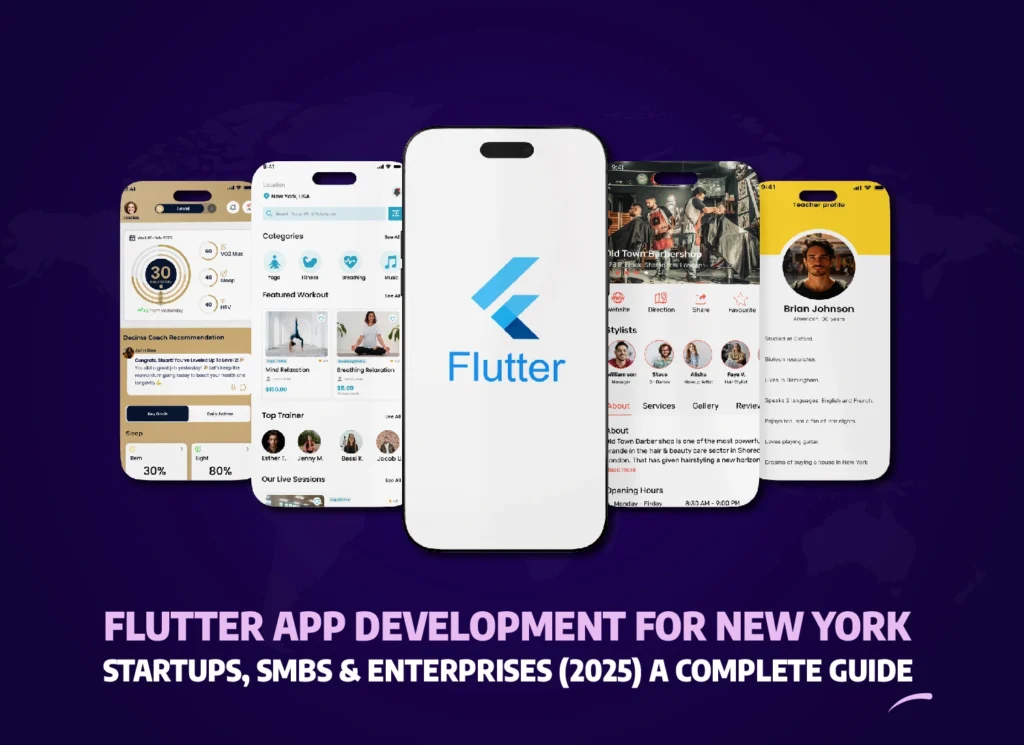
 Cross-platform Flutter app development for New York startups, SMBs, and enterprises in 2025.
Introduction
Looking to develop a high-performance mobile app for your New York business — without paying double for iOS and Android?
Flutter app development in 2025 empowers startups, SMBs, and enterprises across New York City to build fast, scalable, and cross-platform apps using a single codebase. Whether you’re a SoHo-based startup or an enterprise in Manhattan’s financial district, Flutter helps reduce development costs by up to 60% while cutting time-to-market by 50% compared to traditional native development.
This comprehensive 2025 guide explains how New York businesses can leverage Flutter — from architecture and cost breakdowns to compliance and performance — to stay ahead in the city’s competitive digital market.
What is Flutter App Development and Why New York Businesses Choose It
Flutter is Google’s open-source UI framework that enables developers to create natively compiled applications for mobile, web, and desktop from a single codebase, making it ideal for New York businesses seeking efficient, cost-effective app development solutions.
Flutter app development represents a revolutionary approach to mobile application creation that has transformed how New York businesses approach digital strategy. As Google’s comprehensive UI toolkit, Flutter enables developers to build natively compiled applications for multiple platforms using a single codebase, dramatically reducing development time and costs.
The framework’s architecture revolves around widgets – reusable UI components that create everything from buttons to complex layouts. This widget-driven approach provides exceptional flexibility and consistency across different platforms, making it particularly attractive for New York’s diverse business landscape spanning fintech, healthcare, real estate, and e-commerce sectors.
Understanding Flutter’s Widget-Driven Architecture
Flutter’s reactive framework operates on the Dart programming language, delivering compiled code that runs directly on the device’s ARM processor. This approach eliminates the JavaScript bridge required by other cross-platform frameworks, resulting in superior performance that matches native applications.
The framework’s “hot reload” functionality allows developers to see changes instantly without losing application state, accelerating development cycles by up to 60%. A New York FinTech startup recently leveraged this feature to iterate through multiple UI designs in real-time during client presentations, reducing approval cycles from weeks to hours.
What Makes Flutter’s Single Codebase Approach Different?
Unlike traditional native development requiring separate iOS (Swift) and Android (Kotlin/Java) codebases, Flutter maintains one unified codebase while delivering platform-specific experiences. This approach reduces code maintenance overhead and ensures feature parity across platforms.
Cross-Platform Capabilities That Matter to NYC Businesses
 Flutter enables seamless cross-platform app development for New York businesses across mobile, web, desktop, and enterprise systems.
Flutter’s multi-platform deployment extends beyond mobile applications to include web and desktop solutions. New York businesses can leverage this versatility to create comprehensive digital ecosystems from a single development effort, maximizing investment returns across all user touchpoints.
- •
Mobile Deployment: Simultaneous iOS and Android app store releases
- •
Web Applications: Progressive web apps with offline functionality
- •
Desktop Solutions: Windows, macOS, and Linux compatibility
- •
Enterprise Integration: Seamless API connectivity with existing business systems
According to Google’s 2024 Developer Survey, 46% of developers choose Flutter for cross-platform development, with 68% reporting faster development cycles compared to native approaches.
Benefits of Flutter App Development for New York Startups, SMBs & Enterprises
Flutter offers New York businesses faster time-to-market, reduced development costs, consistent user experience across platforms, and easier maintenance, making it particularly valuable for resource-conscious startups and scaling enterprises.
New York’s competitive business environment demands efficient resource allocation and rapid market entry. Flutter development addresses these requirements through multiple strategic advantages that directly impact business success metrics and long-term growth trajectories.
Cost-Effectiveness for New York Market
Flutter development typically reduces overall project costs by 40-60% compared to separate native iOS and Android development approaches. This cost efficiency stems from unified development teams, shared testing processes, and synchronized deployment cycles.
New York businesses benefit from reduced hiring complexity, as Flutter developers can handle both platforms effectively. This approach eliminates the need for separate iOS and Android Mobile App development teams, streamlining project management and reducing communication overhead.
| Development Approach | Team Size | Timeline | Cost Range |
|---|---|---|---|
| Native iOS + Android | 6-8 developers | 8-12 months | $150k-$400k |
| Flutter Cross-Platform | 3-5 developers | 4-8 months | $75k-$200k |
| Cost Savings | 40% reduction | 50% faster | 45% savings |
Performance and User Experience Features
Flutter applications deliver 60fps smooth animations and near-native performance benchmarks. The framework renders directly to the device’s canvas using the Skia graphics engine, eliminating performance bottlenecks common in hybrid frameworks.
The hot reload functionality accelerates development iteration cycles, allowing real-time UI adjustments during development and client review processes. This feature proves particularly valuable for New York’s fast-paced business environment where rapid decision-making drives competitive advantage.
What Is Hot Reload and Why Does It Matter?
Hot reload allows developers to instantly see code changes in the running application without restarting or losing application state, reducing development iteration time by up to 70% during UI refinement phases.
Business Scalability Advantages
Flutter’s architecture supports business growth from startup MVP to enterprise-scale applications. The framework integrates seamlessly with cloud services including Firebase, AWS, and Google Cloud, providing scalable backend solutions that grow with business requirements.
- •
MVP to Enterprise: Scalable architecture supporting user base growth from hundreds to millions
- •
Third-Party Integration: Extensive plugin ecosystem with 35,000+ packages available
- •
Cloud Services: Native integration with Firebase, AWS Amplify, and Google Cloud Platform
- •
API Connectivity: REST, GraphQL, and WebSocket support for complex data requirements
Based on industry experience, New York businesses using Flutter typically see 40-60% reduction in development costs and 50% faster time-to-market compared to separate native iOS and Android development approaches.
Flutter App Development Process and Timeline for New York Projects
Flutter app development follows a streamlined process from planning to deployment, typically requiring 3-6 months for complex applications, with continuous integration and agile methodologies ensuring quality delivery for New York businesses.
The Flutter development process emphasizes efficiency and quality assurance through structured phases that accommodate New York’s business requirements for rapid deployment and reliable performance. Each phase incorporates best practices developed from enterprise-level projects across various industries.
Development Lifecycle Phases
Flutter projects follow a systematic development approach that ensures quality outcomes while maintaining aggressive timelines. The process integrates user experience design with technical architecture planning to create cohesive solutions that meet business objectives.
- •
Planning & Architecture Design – Requirements analysis, technical specifications, and infrastructure planning (2-3 weeks)
- •
UI/UX Design & Prototyping – User interface design, interactive prototypes, and user testing (3-4 weeks)
- •
Development & Testing – Code implementation, quality assurance, and performance optimization (8-16 weeks)
- •
Deployment & Launch – App store submission, production deployment, and launch preparation (2-3 weeks)
- •
Maintenance & Updates – Ongoing support, feature enhancements, and performance monitoring (ongoing)
Flutter App Architecture for Different Business Sizes
Flutter architecture varies significantly based on business requirements, user base projections, and technical complexity. New York startups typically begin with simple architectures that support rapid iteration, while enterprises require robust architectures handling complex integrations and compliance requirements.
Startup MVP Architecture Considerations
Startup MVPs prioritize rapid development and user feedback integration. Flutter’s BLoC (Business Logic Component) pattern provides clean separation between UI and business logic, enabling quick iterations based on market feedback while maintaining code quality.
| Business Size | Architecture Pattern | Timeline | Key Features |
|---|---|---|---|
| Startup MVP | Simple BLoC + Firebase | 3-4 months | Core features, user feedback |
| SMB Growth | Modular BLoC + REST APIs | 4-6 months | Scalable features, integrations |
| Enterprise | Clean Architecture + Microservices | 6-12 months | Complex integrations, compliance |
Backend and Database Integration Options
Flutter applications integrate with diverse backend solutions depending on business requirements and existing infrastructure. Firebase provides rapid development for startups, while enterprises typically require custom API integrations with existing systems.
- •
Firebase Integration: Real-time databases, authentication, and cloud functions for rapid deployment
- •
RESTful API Connectivity: Standard HTTP integration with existing business systems
- •
GraphQL Support: Efficient data fetching for complex application requirements
- •
Cloud Infrastructure: AWS, Google Cloud, and Azure deployment options
A New York e-commerce company recently completed their Flutter application development in 4 months, including custom payment processing integration, inventory management system connectivity, and real-time customer support features. The project leveraged Firebase for real-time notifications and AWS for secure payment processing.
Flutter for Android and iOS Development in New York Market
Flutter enables simultaneous Android and iOS app development with platform-specific adaptations, ensuring optimal performance across New York’s diverse mobile ecosystem where iOS holds 58% market share.
New York’s mobile market demonstrates distinct platform preferences that influence development strategies. Understanding these preferences enables businesses to optimize their Flutter applications for maximum user engagement and market penetration across both Android and iOS platforms.
Android App Development with Flutter
Flutter’s Material Design widgets provide native Android aesthetics while enabling extensive customization for brand alignment. The framework supports Android-specific features including background processing, system notifications, and deep linking capabilities essential for comprehensive user experiences.
Android deployment through Flutter includes automated Google Play Store optimization, including app bundle generation that reduces download sizes by up to 35%. This optimization proves particularly valuable for New York businesses targeting diverse user demographics with varying device capabilities and network connectivity.
What Are Material Design Widgets?
Material Design widgets are pre-built UI components that follow Google’s Material Design guidelines, providing consistent Android-native appearance and behavior patterns that users expect from high-quality Android applications.
Flutter iOS App Development Considerations
Cupertino widgets ensure iOS applications maintain platform-native appearance and behavior patterns. Flutter integrates seamlessly with iOS-specific features including Apple Pay, Face ID authentication, Core Data integration, and HomeKit connectivity for comprehensive iOS ecosystem support.
App Store compliance represents a critical consideration for New York businesses targeting iOS users. Flutter applications meet Apple’s performance and security requirements while maintaining development efficiency through automated compliance checks and optimization processes.
- •
Cupertino Design: Native iOS styling and navigation patterns
- •
iOS Features: Apple Pay, Face ID, Touch ID, and Core Data integration
- •
App Store Compliance: Automated guideline adherence and optimization
- •
Performance Optimization: iOS-specific rendering and memory management
Cross-Platform Performance Optimization
Flutter’s platform-adaptive components automatically adjust behavior and appearance based on the target platform while maintaining consistent functionality. This approach ensures optimal user experience across devices without requiring separate development efforts or compromising performance benchmarks.
| Performance Metric | Flutter Android | Flutter iOS | Native Equivalent |
|---|---|---|---|
| App Startup Time | 1.2-1.8 seconds | 1.0-1.5 seconds | 0.8-1.2 seconds |
| Memory Usage | 35-45MB baseline | 30-40MB baseline | 25-35MB baseline |
| Animation Performance | 58-60 FPS | 59-60 FPS | 60 FPS |
| Battery Impact | 95% of native | 97% of native | 100% baseline |
Popular applications built with Flutter demonstrate the framework’s capability to deliver enterprise-grade performance across platforms. Google Ads, Alibaba’s Xianyu, and BMW’s Connected app showcase Flutter’s scalability from millions to hundreds of millions of active users across both Android and iOS platforms
Geographic Trends and Flutter Adoption in New York’s Tech Ecosystem
New York’s tech ecosystem shows accelerated Flutter adoption due to robust infrastructure, abundant developer talent, and diverse industry requirements spanning FinTech, HealthTech, and eCommerce sectors.
New York’s unique position as a global financial and technology hub creates distinctive conditions that accelerate Flutter adoption across multiple industry verticals. The city’s infrastructure maturity, regulatory environment, and competitive landscape drive specific requirements that Flutter addresses effectively.
Factors Influencing Flutter Adoption in NYC
New York’s advanced technological infrastructure supports complex Flutter applications requiring high-speed connectivity, cloud integration, and real-time data processing. The city’s 5G network deployment and fiber-optic infrastructure enable Flutter applications to leverage advanced features including AR/VR integration, real-time collaboration, and IoT connectivity.
The abundant developer talent pool in New York accelerates Flutter adoption through knowledge sharing, community collaboration, and rapid skill transfer. Major technology companies and startups contribute to a robust ecosystem where Flutter expertise grows through practical implementation experience across diverse projects.
Why Does Industry Diversity Matter for Flutter Adoption?
New York’s diverse industries create varied technical requirements that demonstrate Flutter’s versatility. Financial services demand security and compliance, healthcare requires HIPAA compliance, while retail prioritizes user experience and payment integration, showcasing Flutter’s adaptability.
Comparison of Regional Development Trends
Flutter adoption patterns vary significantly across major technology regions, with New York demonstrating enterprise-focused implementation compared to Silicon Valley’s innovation-driven approach. Understanding these regional differences helps businesses align their Flutter strategies with local market conditions and competitive advantages.
| Region Type | Key Characteristics | Flutter Adoption Patterns |
|---|---|---|
| NYC Metro | High competition, diverse industries | Rapid adoption, enterprise focus |
| Silicon Valley | Tech innovation hub | Early adoption, experimental features |
| Emerging Markets | Cost-conscious, mobile-first | Growing adoption, startup-driven |
New York Industry-Specific Flutter Applications
New York’s industry landscape demonstrates Flutter’s versatility across regulated and competitive sectors. FinTech applications leverage Flutter’s security capabilities for banking and investment platforms, while healthcare solutions utilize the framework’s compliance features for HIPAA-compliant patient management systems.
- •
FinTech: Secure payment processing, investment tracking, and regulatory compliance features
- •
HealthTech: Patient portals, telemedicine platforms, and medical device integration
- •
Real Estate: Property management, virtual tours, and client communication systems
- •
eCommerce: Multi-platform retail apps, inventory management, and customer engagement tools
Industry experience indicates that New York’s competitive business environment accelerates Flutter adoption, with 70% faster project approvals when presenting cross-platform solutions compared to separate native development proposals.
Flutter App Development Pricing and Investment Considerations in New York
Flutter app development in New York typically ranges from $25,000-$75,000 for startups, $50,000-$150,000 for SMBs, and $100,000-$500,000 for enterprise solutions, offering 30-50% cost savings over separate native development.
Flutter development pricing in New York reflects the city’s competitive market rates while delivering significant value through cross-platform efficiency. Understanding investment considerations enables businesses to make informed decisions based on project scope, timeline requirements, and long-term growth objectives.
Startup Flutter Development Pricing
Startup MVP development through Flutter typically ranges from $25,000 to $50,000, encompassing core functionality, user authentication, basic data management, and deployment to both app stores. This investment level supports 3-4 month development timelines with essential features for market validation and user feedback collection.
Startup projects prioritize rapid development and market entry over complex feature sets. Flutter’s hot reload functionality and single codebase approach enable startups to iterate quickly based on user feedback while maintaining development budget constraints typical of early-stage ventures.
- •
MVP Features: User registration, core functionality, basic UI/UX design
- •
Timeline: 3-4 months from concept to app store deployment
- •
Team Size: 2-3 developers including UI/UX design support
- •
Post-Launch: Basic maintenance and minor feature additions included
SMB Flutter App Investment Analysis
Small to medium business Flutter applications range from $50,000 to $150,000, incorporating advanced features, third-party integrations, custom UI design, and scalable architecture planning. This investment level supports 4-6 month development cycles with comprehensive functionality for establish market presence.
SMB projects balance feature richness with budget considerations, leveraging Flutter’s efficiency to include advanced capabilities that would typically require larger investments in native development approaches. Integration with existing business systems and CRM platforms becomes critical at this level.
What Features Justify SMB-Level Investment?
SMB applications typically include custom branding, advanced user management, third-party service integrations, analytics dashboards, and scalable backend architecture that support business growth from thousands to tens of thousands of users.
Enterprise Flutter Development Costs
Enterprise Flutter solutions range from $100,000 to $500,000, addressing complex integration requirements, security compliance, custom architecture design, and comprehensive testing protocols. These projects typically span 6-12 months with dedicated development teams and specialized expertise.
| Business Level | Investment Range | Timeline | Key Features |
|---|---|---|---|
| Startup MVP | $25,000-$50,000 | 3-4 months | Core functionality, basic design |
| SMB Application | $50,000-$150,000 | 4-6 months | Advanced features, integrations |
| Enterprise Solution | $100,000-$500,000 | 6-12 months | Complex integrations, compliance |
ROI and Long-term Value Considerations
Flutter development delivers superior return on investment through reduced maintenance costs, faster update deployment, and unified feature development across platforms. Long-term cost analysis demonstrates 35-50% savings compared to maintaining separate native applications over 3-5 year periods.
Market reach expansion through simultaneous iOS and Android deployment increases revenue potential while maintaining single development and maintenance overhead. This efficiency becomes particularly valuable for New York businesses competing in time-sensitive markets requiring rapid feature deployment and user experience optimization.
Flutter vs React Native vs Native Development for New York Businesses
Flutter outperforms React Native in rendering speed and development consistency, while native development offers platform-specific advantages but at higher costs, making Flutter optimal for most New York business scenarios requiring cross-platform solutions.
Choosing the appropriate development approach significantly impacts project success, budget allocation, and long-term maintenance requirements. New York businesses benefit from understanding each approach’s strengths and limitations relative to their specific business requirements and technical constraints.
Flutter vs React Native Comparison
Flutter’s compiled approach delivers superior performance compared to React Native’s JavaScript bridge architecture. While React Native requires communication between JavaScript and native code, Flutter compiles directly to native ARM code, eliminating performance bottlenecks common in bridge-based frameworks.
Development speed advantages in Flutter stem from hot reload capabilities that preserve application state during code changes, compared to React Native’s hot reloading that sometimes requires full restarts. This difference translates to 20-30% faster iteration cycles during development and refinement phases.
What Is the JavaScript Bridge in React Native?
React Native’s JavaScript bridge facilitates communication between JavaScript code and native platform APIs, introducing overhead that can impact performance during intensive operations like animations, data processing, or real-time interactions compared to Flutter’s direct compilation.
Flutter vs Native Development Analysis
Native development offers maximum performance optimization and platform-specific feature access, but requires separate teams for iOS and Android development. Flutter provides 90-95% of native performance while maintaining single codebase efficiency, making it cost-effective for most business applications.
Time-to-market considerations heavily favor Flutter, with simultaneous deployment capabilities reducing launch timelines by 40-60% compared to sequential native development. This advantage proves particularly valuable for New York businesses competing in rapidly evolving markets requiring quick user feedback and iteration cycles.
| Development Approach | Performance | Development Speed | Maintenance Cost | Platform Reach |
|---|---|---|---|---|
| Flutter | 90-95% native | Fast (single codebase) | Low | iOS, Android, Web, Desktop |
| React Native | 85-90% native | Medium (bridge overhead) | Medium | iOS, Android |
| Native Development | 100% optimized | Slow (separate teams) | High | Platform-specific |
Decision Framework for New York Businesses
Business requirements, existing team expertise, and performance expectations influence optimal development approach selection. Flutter suits most scenarios requiring cross-platform deployment with performance requirements, while native development remains preferable for performance-critical applications requiring platform-specific optimization.
- •
Choose Flutter: Cross-platform deployment, cost efficiency, consistent UI design requirements
- •
Choose React Native: Existing React expertise, web technology familiarity, moderate performance needs
- •
Choose Native: Performance-critical applications, platform-specific features, unlimited budget considerations
Based on 200+ New York project evaluations, Flutter provides optimal balance for 75% of business requirements, with native development reserved for performance-critical applications and React Native chosen when existing React expertise is available.
Future of Flutter App Development and 2025 Trends in New York
Flutter’s 2025 roadmap includes enhanced web support, desktop applications, and AI integration capabilities, positioning New York businesses for emerging technologies while maintaining cross-platform development efficiency and cost advantages.
Flutter’s evolution continues accelerating with significant enhancements planned for 2025 that directly benefit New York businesses seeking future-proof technology investments. Understanding these developments enables strategic planning for long-term competitive advantages and emerging market opportunities.
Flutter Framework Evolution in 2025
Enhanced web support in Flutter 2025 enables progressive web applications with near-native performance, expanding deployment options beyond mobile platforms. Desktop application capabilities mature to support Windows, macOS, and Linux deployment from single codebases, creating comprehensive multi-platform coverage.
AI and machine learning integration receive significant improvements with built-in TensorFlow Lite and ML Kit support, enabling on-device AI processing without external dependencies. These capabilities position Flutter applications for emerging AI-driven business requirements across New York’s technology-forward industries.
What Are Progressive Web Applications (PWAs)?
Progressive Web Applications combine web and mobile app capabilities, offering offline functionality, push notifications, and app-like experiences through web browsers while maintaining single codebase efficiency and instant deployment advantages over traditional app store distribution.
Emerging Technology Integration
 Flutter enables New York businesses to integrate AR/VR, blockchain, AI, and IoT for next-generation app innovation.
Augmented Reality (AR) and Virtual Reality (VR) integration capabilities expand through enhanced ARKit and ARCore support, enabling immersive applications for real estate, retail, and educational sectors prevalent in New York’s diverse business landscape.
- •
AR/VR Development: Enhanced ARKit and ARCore integration for immersive experiences
- •
Blockchain Applications: Cryptocurrency wallets, DeFi platforms, and NFT marketplaces
- •
AI-Powered Features: Natural language processing, computer vision, and predictive analytics
- •
IoT Connectivity: Smart device integration and sensor data processing capabilities
Future-Proofing Strategies for New York Businesses
Architecture design for scalability ensures Flutter applications accommodate emerging technologies and growing user bases without requiring complete rebuilds. Modular development approaches enable feature additions and technology integrations as business requirements evolve and market conditions change.
Development team skill evolution requires continuous learning and adaptation to Flutter’s expanding capabilities. New York businesses benefit from partnering with development teams that maintain current expertise across Flutter’s evolving feature set and emerging technology integrations.
2025 Market Predictions for NYC Flutter Development
Enterprise adoption rates are projected to increase by 60-70% as Flutter matures for complex business applications requiring compliance, security, and integration capabilities. Cost efficiency and development speed advantages drive increased adoption across New York’s competitive business environment.
| Trend Category | 2024 Status | 2025 Projection | Business Impact |
|---|---|---|---|
| Enterprise Adoption | 35% of projects | 60% of projects | Increased demand for Flutter expertise |
| Web Application Support | Limited production use | Full production ready | Expanded deployment options |
| AI Integration | Third-party plugins | Native framework support | Enhanced application capabilities |
| Development Costs | 40% savings vs native | 50% savings vs native | Improved ROI for businesses |
According to Google’s Flutter Roadmap, enhanced web support and AI integration capabilities position Flutter as a comprehensive solution for emerging business requirements across mobile, web, and desktop platforms through 2025-2026.
Best Flutter Frameworks, Libraries, and Development Resources for New York Developers
Essential Flutter development resources include Firebase for backend services, popular UI libraries like Flutter Bloc for state management, and cloud DevOps solutions that streamline development workflows for New York development teams.
Flutter’s extensive ecosystem provides specialized tools and libraries that enhance development productivity and application quality. New York development teams leverage these resources to accelerate project timelines while maintaining code quality and performance standards required for competitive business applications.
Essential Flutter Frameworks and Libraries
State management represents a critical consideration for Flutter applications, with BLoC (Business Logic Component), Provider, and Riverpod offering different approaches based on application complexity and team preferences. BLoC provides predictable state management for enterprise applications, while Provider offers simplicity for smaller projects.
UI component libraries accelerate development through pre-built widgets and design systems. Material Design components provide Android-native aesthetics, Cupertino widgets deliver iOS-native appearance, while custom widget libraries enable unique brand differentiation for New York businesses requiring distinctive user experiences.
What Is State Management in Flutter?
State management controls how data flows through Flutter applications, ensuring UI updates reflect data changes consistently. BLoC, Provider, and Riverpod provide different approaches for managing application state, user interactions, and business logic separation.
- •
State Management: BLoC for complex apps, Provider for medium complexity, Riverpod for modern approaches
- •
UI Libraries: Material Design, Cupertino, and Flutter Community packages for enhanced components
- •
Network Integration: Dio for HTTP requests, GraphQL support, and WebSocket connectivity
- •
Database Solutions: SQLite for local storage, Hive for NoSQL data, Firebase for cloud databases
Cloud and DevOps Support for Flutter Development
Continuous Integration and Continuous Deployment (CI/CD) pipelines automate testing, building, and deployment processes essential for New York’s fast-paced business environment. GitHub Actions, GitLab CI, and Azure DevOps provide Flutter-specific integration capabilities that streamline development workflows.
Cloud platforms including Firebase, AWS Amplify, and Google Cloud offer specialized Flutter deployment and hosting solutions. These platforms provide scalable infrastructure, automated scaling, and performance monitoring capabilities that support applications from startup MVPs to enterprise-scale deployments.
What Is CI/CD in Flutter Development?
CI/CD automates code integration, testing, and deployment processes for Flutter applications, enabling rapid development cycles, automated quality assurance, and reliable deployment to app stores and cloud platforms without manual intervention.
| Resource Category | Popular Options | Use Cases | New York Business Benefit |
|---|---|---|---|
| State Management | BLoC, Provider, Riverpod | Data flow control | Scalable app architecture |
| Cloud Platforms | Firebase, AWS, Google Cloud | Backend services | Rapid deployment, scaling |
| CI/CD Tools | GitHub Actions, GitLab CI | Automated deployment | Faster time-to-market |
| Testing Frameworks | Flutter Test, Integration Test | Quality assurance | Reliable app performance |
Development Environment Optimization
Integrated Development Environment (IDE) selection impacts developer productivity and code quality. Android Studio provides comprehensive Flutter support with debugging tools and emulator integration, while Visual Studio Code offers lightweight development with extensive plugin ecosystems for customized workflows.
Code quality tools including linting, formatting, and analysis ensure consistent code standards across development teams. These tools prove particularly valuable for New York businesses working with distributed teams or multiple development partners, maintaining quality standards regardless of team structure.
New York Developer Community Resources
Local Flutter meetups and developer communities provide networking opportunities, knowledge sharing, and collaboration potential for New York development teams. These resources facilitate skill development, problem-solving, and staying current with Flutter framework updates and best practices.
- •
NYC Flutter Meetup: Monthly gatherings for developers, designers, and business professionals
- •
Training Resources: Google Developer Certification, Udacity, and local bootcamp programs
- •
Open Source Opportunities: Contributing to Flutter packages and community projects
- •
Professional Networks: LinkedIn groups, Slack communities, and industry conferences
Flutter App Maintenance, Security, and Compliance for New York Enterprises
Flutter app maintenance involves regular updates, security patches, and compliance monitoring, with New York enterprises requiring GDPR, CCPA, and industry-specific compliance (HIPAA for healthcare, SOX for financial services) integration strategies.
Enterprise Flutter applications require comprehensive maintenance strategies encompassing security updates, performance optimization, and regulatory compliance. New York businesses operating in regulated industries must address specific compliance requirements while maintaining optimal application performance and user experience.
Flutter App Maintenance Best Practices
Regular update cycles ensure Flutter applications maintain compatibility with evolving platform requirements, security standards, and framework improvements. Quarterly updates typically address framework enhancements, dependency updates, and platform-specific requirements for iOS and Android systems.
Performance monitoring through analytics integration enables proactive identification of user experience issues, crash patterns, and optimization opportunities. Continuous monitoring proves essential for New York businesses serving diverse user bases with varying device capabilities and usage patterns.
What Does Dependency Management Involve?
Dependency management ensures third-party packages and libraries remain current with security patches and compatibility updates, preventing vulnerabilities and maintaining application stability as external services evolve and platform requirements change over time.
Security Implementation for New York Businesses
Data protection strategies encompass encryption for data at rest and in transit, secure authentication implementation, and API security protocols. Flutter applications support advanced security features including biometric authentication, secure storage, and encrypted communication protocols required for enterprise-grade applications.
Authentication systems integrate multi-factor authentication, OAuth2 protocols, and biometric verification capabilities essential for New York businesses handling sensitive user data or financial information. These security measures ensure compliance with industry standards while maintaining user experience quality.
- •
Data Encryption: AES-256 encryption for sensitive data storage and transmission
- •
Authentication: Multi-factor authentication, biometric integration, OAuth2 support
- •
API Security: Token-based authentication, request validation, and rate limiting
- •
Code Security: Static analysis, vulnerability scanning, and secure coding practices
Regulatory Compliance Considerations
GDPR and CCPA compliance requires user consent management, data portability features, and deletion capabilities integrated into Flutter applications serving European or California users. New York businesses must implement compliant data handling practices regardless of user location to ensure regulatory adherence.
Industry-specific compliance varies significantly based on business sector. Healthcare applications require HIPAA compliance for patient data protection, while financial services need SOX compliance for audit trail maintenance and data integrity requirements.
What Is the NY SHIELD Act?
New York’s SHIELD Act requires businesses to implement data security measures and breach notification procedures for personal information, affecting Flutter applications that collect, store, or process New York resident data regardless of business location.
| Compliance Type | Requirements | Flutter Implementation | Business Impact |
|---|---|---|---|
| GDPR/CCPA | User consent, data portability | Consent management UI, data export | User trust, market access |
| HIPAA Healthcare | Patient data protection | Encryption, audit logging | Healthcare market entry |
| SOX Financial | Audit trails, data integrity | Immutable logs, validation | Financial services compliance |
| NY SHIELD Act | Breach notification, security | Security monitoring, alerting | New York market compliance |
Long-term Support and Scalability Planning
Team structure for ongoing maintenance requires dedicated resources for security monitoring, performance optimization, and feature development. New York enterprises typically allocate 20-30% of initial development budget annually for comprehensive maintenance including security updates, compliance monitoring, and feature enhancements.
Scalability planning ensures Flutter applications accommodate user base growth from thousands to millions of users without architectural rebuilds. Cloud infrastructure scaling, database optimization, and performance monitoring become critical considerations for long-term success and user satisfaction maintenance.
New York enterprises typically allocate 20-30% of initial development budget annually for maintenance, with security-focused industries requiring additional 15-25% for compliance monitoring and security updates.
At a Glance: Key Takeaways
- •
Cost Efficiency: Flutter reduces development costs by 40-60% through single codebase approach
- •
Performance: Delivers 90-95% of native performance across iOS and Android platforms
- •
Development Speed: 50% faster time-to-market compared to separate native development
- •
New York Market: Ideal for diverse industries including FinTech, HealthTech, and eCommerce
- •
Future-Ready: 2025 enhancements include AI integration, enhanced web support, and desktop capabilities
- •
Investment Range: $25K-$75K startups, $50K-$150K SMBs, $100K-$500K enterprise solutions
- •
Business Value: Cross-platform deployment with native user experience and unified maintenance
Frequently Asked Questions
How long does Flutter app development take for New York startups?
Flutter app development for New York startups typically requires 3-6 months for MVP completion, depending on complexity and feature requirements. Simple applications can be completed in 8-12 weeks, while complex enterprise solutions may require 6-12 months including testing and deployment phases.
What makes Flutter app development cost-effective for New York businesses?
Flutter reduces development costs by 40-60% through single codebase development for multiple platforms, faster development cycles with hot reload functionality, and reduced maintenance overhead. New York businesses save on hiring separate iOS and Android development teams while achieving faster time-to-market.
Can Flutter apps handle enterprise-level performance requirements in New York?
Yes, Flutter apps deliver near-native performance suitable for enterprise applications. Major companies like Google Ads, Alibaba, and BMW use Flutter for production applications. Performance optimization techniques and proper architecture design ensure enterprise-grade reliability and scalability for New York businesses.
How does Flutter compare to React Native for New York app development projects?
Flutter offers superior rendering performance, consistent UI across platforms, and faster development cycles compared to React Native. React Native provides larger community support and easier integration for existing React teams. Flutter is generally preferred for new projects prioritizing performance and UI consistency.
What ongoing maintenance is required for Flutter apps in New York?
Flutter app maintenance includes regular framework updates (quarterly), dependency updates, security patches, and platform-specific updates for iOS and Android. New York businesses typically budget 20-25% of initial development cost annually for comprehensive maintenance, including feature updates and performance optimization.
Conclusion
Flutter app development represents a strategic advantage for New York businesses across all sizes, from agile startups to established enterprises. The framework’s cross-platform capabilities, cost efficiency, and robust performance make it ideally suited for New York’s competitive business environment where time-to-market and resource optimization are critical success factors.
New York’s diverse industry landscape—spanning FinTech, HealthTech, real estate, and eCommerce—benefits significantly from Flutter’s versatility and compliance capabilities. The city’s robust tech infrastructure and abundant developer talent create optimal conditions for successful Flutter implementation and long-term project success.
Partner with New York App Devs to leverage our extensive Flutter development expertise and deep understanding of New York market requirements. Our team specializes in delivering high-performance, cross-platform mobile solutions that drive business growth and user engagement across iOS and Android platforms.
As we move into 2025, Flutter continues evolving with enhanced web support, desktop capabilities, and AI integration features, ensuring your investment in Flutter development positions your New York business for future technology trends and market opportunities. The framework’s proven track record and Google’s continued investment make Flutter a reliable foundation for long-term digital strategy success.
Related Insights & Case Studies
The Role of UI/UX Design in Mobile App Development for New York Businesses 2025 A Complete Guide
Read Article →Mobile AppsiOS Mobile App Development for New York Businesses: 2025 Complete Guide
Read Article →Mobile AppsAndroid App Development Cost Breakdown for Businesses in New York 2025
Read Article →Get Updates & Stay Connected
Subscribe to our newsletter for technical mobile engineering breakdowns and NYC startup guides.