Planning a mobile app for your New York enterprise but unsure about the investment required? With mobile app development costs ranging from $50,000 to $500,000+ in 2025, understanding the complete cost breakdown is crucial for NYC businesses looking to make informed decisions and maximize their ROI.
This comprehensive guide breaks down mobile app development costs for New York enterprises in 2025, covering platform choices, feature complexity, and regional pricing factors to help businesses budget effectively.
Mobile app development costs for New York enterprises in 2025 range from $75,000-$150,000 for basic apps, $150,000-$300,000 for mid-complexity apps, and $300,000-$500,000+ for enterprise-grade applications with advanced features.
The mobile app development landscape in New York has evolved significantly, with enterprises facing diverse pricing structures based on complexity, platform choice, and feature requirements. Understanding these cost ranges helps businesses plan their digital transformation strategies effectively.
Simple apps with basic functionality, 3-5 screens, and standard UI elements typically cost between $75,000-$150,000. These include basic business apps with limited integrations and straightforward user interfaces that serve essential business functions.
Medium complexity apps featuring custom UI, API integrations, user profiles, and advanced navigation cost $150,000-$300,000. These applications often include e-commerce functionality or industry-specific features that require specialized development expertise.
Complex enterprise apps with advanced features, AI integration, extensive backend systems, and multi-platform synchronization range from $300,000-$500,000+. These comprehensive solutions often serve healthcare or fintech enterprises requiring robust security and compliance features.
Local developer rates in New York range from $100-$200 per hour, reflecting the city’s premium talent pool and higher operational costs. According to Clutch’s 2024 market analysis, NYC developers command these premium rates due to their expertise in cutting-edge technologies and enterprise-level projects.
| App Type | Development Time | NYC Cost Range | Key Features |
|---|---|---|---|
| Simple | 3-6 months | $75K-$150K | Basic UI, limited features |
| Medium Complexity | 6-12 months | $150K-$300K | Custom UI, API integrations |
| Enterprise Complex | 12-18 months | $300K-$500K+ | AI features, advanced security |
Native iOS development costs 10-15% more than Android due to Apple’s strict guidelines, while cross-platform solutions using React Native or Flutter can reduce overall costs by 30-40% for NYC enterprises.
Platform selection significantly impacts development costs, with each approach offering distinct advantages and pricing structures. New York enterprises must consider their target audience, performance requirements, and budget constraints when making platform decisions.
iOS development typically costs $80,000-$200,000 due to Apple’s stringent app store guidelines and the need for extensive testing across different device configurations. The platform requires specialized Swift or Objective-C expertise, contributing to higher development rates.
Android development ranges from $70,000-$180,000, offering slightly lower costs due to more flexible development requirements. However, Android’s device fragmentation can increase testing and optimization expenses for enterprise applications.
iOS development requires adherence to Apple’s Human Interface Guidelines and App Store Review Guidelines, which can extend development timelines but ensures consistent user experiences across Apple devices.
React Native development costs $60,000-$150,000, providing significant savings through code reusability across iOS and Android platforms. This framework allows developers to write once and deploy everywhere, reducing development time by 30-40%.
Flutter development ranges from $65,000-$160,000, offering Google’s cross-platform solution with native performance characteristics. Flutter’s single codebase approach makes it ideal for enterprises requiring consistent functionality across multiple platforms.
Hybrid solutions provide cost-effective alternatives for enterprises prioritizing speed-to-market and budget optimization. These approaches typically reduce overall development costs while maintaining acceptable performance levels for business applications.
Planning is the key to success. Click here for a free consultation and personalized cost estimation to help guide your enterprise’s mobile app journey.
| Platform | Development Cost | Time to Market | Maintenance Cost |
|---|---|---|---|
| Native iOS | $80K-$200K | 4-8 months | 15-20% annually |
| Native Android | $70K-$180K | 4-8 months | 15-20% annually |
| Cross-Platform | $60K-$160K | 3-6 months | 12-18% annually |
Calculate app development costs by multiplying estimated development hours (300-2000+ hours) by developer rates ($100-$200/hour in NYC), plus additional costs for design, testing, and deployment (typically 20-30% of development cost).
Accurate cost calculation requires systematic evaluation of project requirements, feature complexity, and resource allocation. New York enterprises benefit from structured approaches to budgeting that account for all development phases and potential variables.
Feature documentation forms the foundation of accurate cost estimation. Businesses should create comprehensive lists of required functionality, user workflows, and integration requirements before engaging development teams.
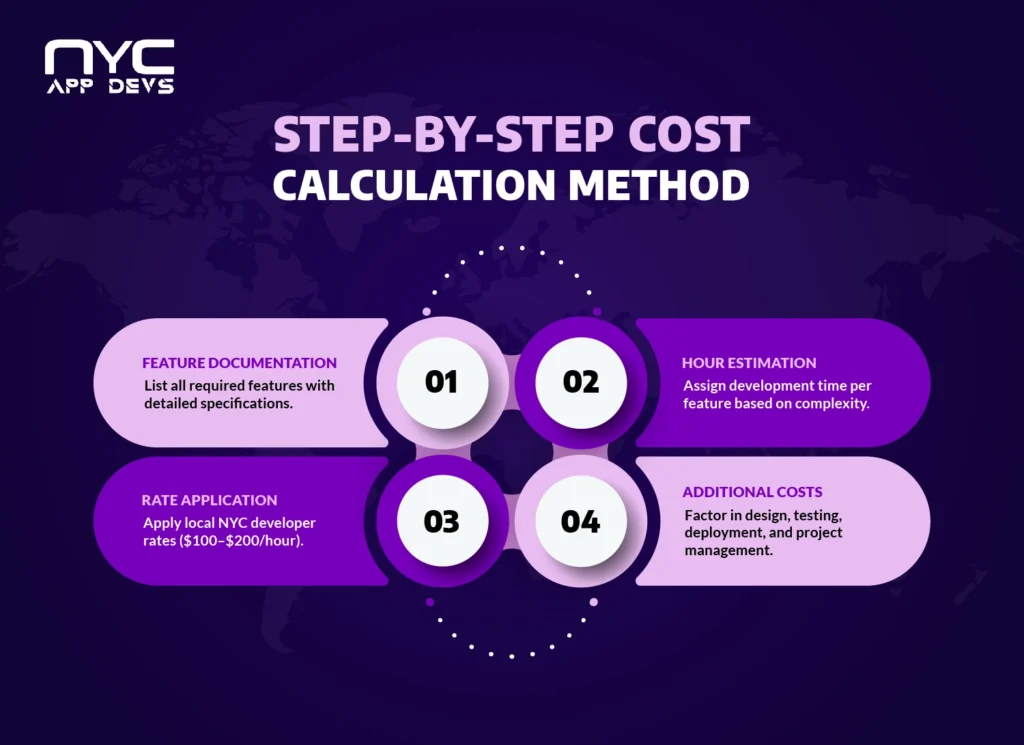
Development time estimation varies significantly based on feature complexity and integration requirements. Simple features like user registration may require 20-40 hours, while complex features like real-time analytics can demand 100-200+ hours of development time.
Base development hours typically range from 300 hours for simple apps to 2000+ hours for enterprise-grade applications. This estimation includes frontend development, backend integration, and basic testing phases.
Design and UX/UI costs represent 15-20% of total project budget, covering user interface design, user experience optimization, and visual asset creation. Quality assurance and testing add another 10-15% to ensure app reliability and performance.
| Cost Component | Percentage of Budget | NYC Rate Range |
|---|---|---|
| Development | 60-70% | $100-$200/hour |
| Design & UX/UI | 15-20% | $80-$150/hour |
| Testing & QA | 10-15% | $60-$120/hour |
| Project Management | 10-12% | $80-$150/hour |
NYC mobile app development costs are 15-25% higher than national averages due to premium talent pool, higher operational costs, and competitive market dynamics, but offer superior expertise and faster project delivery.
Regional pricing variations significantly impact enterprise budgeting decisions, with New York’s premium market positioning offering distinct advantages that justify higher investment levels. Understanding these regional factors helps businesses evaluate value propositions effectively.
New York’s talent pool premium provides access to developers with extensive experience in enterprise-level projects, cutting-edge technologies, and complex business requirements. According to Glassdoor’s 2024 salary data, NYC mobile developers command higher salaries due to their specialized expertise and market demand.
Operational costs including office rent, utilities, and business expenses in Manhattan and other NYC boroughs significantly exceed national averages, directly impacting development company pricing structures. These costs are offset by improved communication, faster project delivery, and reduced management overhead.
NYC’s competitive market environment drives innovation and quality standards, with development companies investing heavily in talent acquisition, technology infrastructure, and client service capabilities to maintain market positioning.
| Region Type | Hourly Rate Range | Project Cost Premium | Quality Level |
|---|---|---|---|
| NYC Metro | $100-$200 | 15-25% above national | Premium expertise |
| National Average | $75-$150 | Baseline pricing | Standard quality |
| Offshore | $25-$75 | 50-70% below NYC | Variable quality |
Based on industry experience, NYC’s higher development costs often translate to faster delivery, better communication, and superior technical expertise, making it worthwhile for enterprise-level projects requiring premium quality and reliability.
Enterprise mobile app features like advanced security, API integrations, analytics, and scalability add $20,000-$100,000+ to base development costs, depending on complexity and compliance requirements.
Enterprise applications require sophisticated features that distinguish them from consumer apps, including robust security frameworks, complex integrations, and scalability considerations. These requirements significantly impact development costs but provide essential business value.
User authentication and security systems cost $5,000-$15,000, incorporating multi-factor authentication, biometric security, and enterprise-grade encryption protocols. These features are particularly crucial for fintech applications and other regulated industries.
API integrations range from $8,000-$25,000 depending on the number and complexity of third-party services, enterprise systems, and custom backend connections. Common integrations include CRM systems, payment processors, and business intelligence platforms.
AI/ML integration represents a significant investment at $25,000-$75,000, covering machine learning model development, data processing capabilities, and intelligent automation features. These technologies are increasingly essential for competitive advantage in enterprise applications.
Real-time features including live chat, real-time data updates, and collaborative functionality cost $15,000-$40,000. These features are particularly valuable for healthcare applications requiring immediate data access and communication.
Compliance features ensure adherence to industry regulations like HIPAA, SOX, or PCI-DSS, costing $10,000-$50,000 depending on requirements. These features include audit trails, data encryption, access controls, and regulatory reporting capabilities.
| Feature Category | Cost Range | Development Time | Business Value |
|---|---|---|---|
| Authentication & Security | $5K-$15K | 2-4 weeks | Data protection |
| API Integrations | $8K-$25K | 3-6 weeks | System connectivity |
| AI/ML Features | $25K-$75K | 6-12 weeks | Competitive advantage |
| Compliance Features | $10K-$50K | 4-8 weeks | Regulatory adherence |
NYC enterprises can reduce mobile app development costs by 30-50% through MVP development, offshore partnerships, cross-platform technologies, and phased development approaches while maintaining quality standards.
Strategic cost optimization enables New York enterprises to achieve their digital transformation goals within budget constraints while maintaining quality and functionality standards. These approaches focus on maximizing value rather than minimizing features.
Minimum Viable Product development reduces initial costs by 40-60% through focused feature sets that address core user needs. This approach allows enterprises to validate market assumptions, gather user feedback, and iterate based on real-world usage data.
MVP development typically includes essential features like user authentication, core functionality, basic UI/UX, and fundamental integrations. Secondary features are added in subsequent development phases based on user feedback and business priorities.
Iterative development allows businesses to spread costs over multiple phases while continuously improving user experience and adding valuable features. This approach reduces financial risk and enables more accurate budget planning for future enhancements.
Cross-platform development using React Native or Flutter saves 30-40% on multi-platform deployment costs. These technologies enable code sharing between iOS and Android platforms while maintaining native performance characteristics.
Offshore development teams can reduce labor costs by 50-70% while maintaining quality through proper project management and communication protocols. However, enterprises must carefully evaluate time zone differences, communication challenges, and quality control requirements.
Industry experience shows that strategic cost optimization through MVP approaches and cross-platform development can deliver 70% of enterprise value at 50% of the cost, making it ideal for budget-conscious NYC businesses seeking competitive advantage.
| Cost Reduction Strategy | Savings Potential | Quality Impact | Implementation Time |
|---|---|---|---|
| MVP Development | 40-60% | Maintained | 3-6 months |
| Cross-Platform | 30-40% | Slight reduction | 20% faster |
| Offshore Teams | 50-70% | Variable | Similar |
| Pre-built Solutions | 20-30% | Maintained | 30% faster |
Hidden mobile app development costs include ongoing maintenance (15-20% annually), App Store fees, hosting expenses, and compliance updates, typically adding 25-35% to the initial development budget over the first year.
Comprehensive budget planning requires consideration of post-launch expenses that many enterprises overlook during initial cost estimation. These ongoing costs are essential for maintaining app performance, security, and user satisfaction over time.
App Store fees represent minimal but necessary ongoing expenses, with Apple charging $99 annually for developer program membership and Google requiring a $25 one-time registration fee. These fees enable app distribution and access to platform-specific development tools.
Cloud hosting costs range from $200-$5,000+ monthly depending on user volume, data storage requirements, and performance specifications. Enterprise applications with high user volumes and complex backend systems require robust hosting infrastructure that scales with business growth.
Maintenance and updates consume 15-20% of the original development cost annually, covering bug fixes, performance optimization, feature enhancements, and platform compatibility updates. Regular maintenance ensures continued app functionality as operating systems evolve.
Security audits cost $5,000-$15,000 annually for enterprise applications, ensuring continued compliance with security standards and identifying potential vulnerabilities. These audits are particularly crucial for healthcare and finance applications handling sensitive data.
Regulatory compliance updates range from $10,000-$30,000 annually, covering changes in industry regulations, privacy laws, and security requirements. Enterprises operating in multiple jurisdictions face higher compliance costs due to varying regulatory requirements.
| Ongoing Cost Category | Annual Cost Range | Frequency | Business Impact |
|---|---|---|---|
| Maintenance & Updates | 15-20% of dev cost | Continuous | Performance & reliability |
| Cloud Hosting | $2.4K-$60K | Monthly | App availability |
| Security Audits | $5K-$15K | Annual | Data protection |
| Compliance Updates | $10K-$30K | As needed | Regulatory adherence |
Selecting the right NYC mobile app development company involves evaluating portfolio quality, technical expertise, communication capabilities, and cost transparency, with premium agencies charging $150-$200/hour but delivering superior results.
Partnership selection significantly impacts project success, cost efficiency, and long-term maintenance requirements. New York enterprises benefit from thorough evaluation processes that assess technical capabilities, business understanding, and cultural alignment.
Portfolio evaluation should focus on enterprise app success stories, similar industry experience, and technical complexity comparable to your project requirements. Companies with proven experience in your industry understand regulatory requirements, user expectations, and technical challenges.
Technical expertise assessment should cover modern technology stacks, security best practices, scalability approaches, and emerging technology integration capabilities. Leading development companies demonstrate proficiency across multiple platforms and frameworks.
Agile methodologies ensure transparent communication, regular progress updates, and flexible adaptation to changing requirements. Effective project management reduces costs through efficient resource allocation and timeline adherence.
Dedicated team models cost $15,000-$30,000 monthly, providing consistent resource allocation and deep project knowledge. This approach works best for long-term projects requiring ongoing development and maintenance support.
Fixed project cost arrangements provide budget certainty with defined scope and deliverables. This model suits enterprises with well-defined requirements and limited scope changes during development.
Hourly rate models at $100-$200/hour offer flexibility for projects with evolving requirements or undefined scope. This approach requires careful project management to control costs while maintaining quality standards.
| Engagement Model | Cost Structure | Best For | Risk Level |
|---|---|---|---|
| Dedicated Team | $15K-$30K/month | Long-term projects | Low |
| Fixed Project | Total budget | Defined scope | Medium |
| Hourly Rate | $100-$200/hour | Flexible scope | High |
| Hybrid Model | Mixed structure | Complex projects | Medium |
Find out before it’s too late. Click here for a personalized review of your app development strategy and cost breakdown.
Mobile app development costs for New York enterprises typically range from $75,000 for basic apps to $500,000+ for complex enterprise solutions in 2025, with factors like features, platforms, and local developer rates influencing final pricing.
The average mobile app development cost in NYC is $150,000-$250,000 for medium-complexity business apps, reflecting the city’s premium developer rates of $100-$200/hour and higher operational costs compared to national averages.
NYC enterprises can reduce development costs by 30-50% through MVP development, cross-platform technologies, offshore partnerships, and phased development approaches while maintaining quality and meeting business objectives effectively.
Hidden costs include ongoing maintenance (15-20% annually), cloud hosting ($200-$5,000/month), App Store fees, security updates, and compliance requirements, typically adding 25-35% to initial development budgets.
Cross-platform development using React Native or Flutter can save NYC enterprises 30-40% on costs while reaching both iOS and Android users, making it ideal for budget-conscious businesses without sacrificing quality.
Key factors include app complexity, platform choice, developer rates ($100-$200/hour), compliance requirements, integration needs, and ongoing maintenance costs, with NYC’s premium market commanding higher rates for superior expertise.
Understanding mobile app development costs is crucial for NYC enterprises planning digital transformation in 2025. With proper budgeting, strategic technology choices, and the right development partner, businesses can create powerful mobile solutions that drive growth while managing costs effectively.
New York’s competitive tech landscape offers access to world-class development talent, making it an ideal location for enterprise mobile app projects that require premium quality and expertise. The city’s developers understand complex business requirements and deliver solutions that meet enterprise-grade standards.
Ready to discuss your mobile app project? Contact New York App Devs for a comprehensive cost analysis and strategic consultation tailored to your enterprise needs and budget requirements.
The mobile app development landscape continues evolving rapidly, making expert guidance essential for maximizing your technology investment and achieving measurable business results that drive competitive advantage in today’s digital marketplace.